
Why India's Creative Industry Needs a CRM Built for How It Actually Works
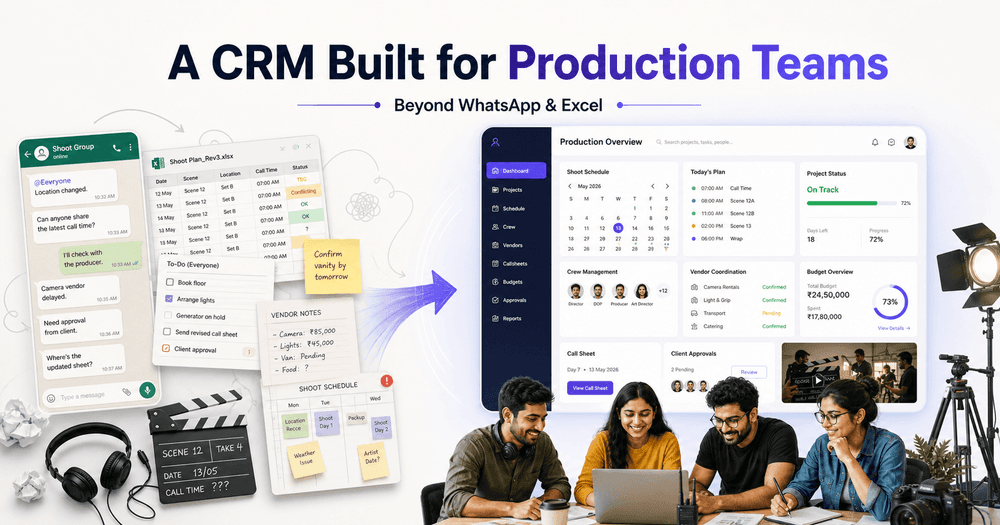
Production runs on WhatsApp threads, Excel sheets, and people's memories. Generic CRMs don't fit because the work doesn't fit them. Here's what a CRM built for how India's creative industry actually works should look like — and why this is the moment it becomes possible.
Why India's Creative Industry Needs a CRM Built for How It Actually Works
Production runs on WhatsApp threads, Excel sheets, and people's memories. That's not a CRM problem — until it is.
If you ask a production manager in Mumbai how they keep track of their creator network, the honest answer is some mix of: a WhatsApp Business account with 400 contacts, an Excel sheet that's three years out of date, the iPhone notes app, a Google Doc shared with one assistant, and what they remember when someone calls. If you ask how they track active deals, you get a similar answer with different tools — Trello on a good day, sticky notes on a real one.
This isn't dysfunction. It's how the industry has always worked, and for individual producers running 10 projects a year with a tight network, it works fine. The problem isn't that any single tool is missing. The problem is that the work itself doesn't fit the tools that exist.
Most CRMs were designed for B2B sales pipelines: leads come in, get qualified, move through stages, close as deals. The unit of work is a "lead" or "contact" or "opportunity." The data model assumes you're trying to sell something to someone who has a budget and a buying process. Pipedrive, HubSpot, Salesforce — all built around this model.
Production work doesn't look anything like that.
In production, every project is its own micro-organization with its own crew, its own budget, its own timeline, and its own paperwork. A "deal" isn't a conversation that closes — it's a 40-person operation that needs scheduling, contracts, invoices, deliverables, and follow-up. A "contact" isn't a buyer — it's a freelance DOP who's available three days next month, charges ₹35,000/day with their own gear, and has worked with you four times before. The unit of work is the project, and every project drags 30 other entities along with it.
That's why generic CRMs feel useless to production teams. The fields don't match. The workflow doesn't match. The reports don't match. People install Pipedrive, force-fit it for two weeks, and quietly go back to Excel.
What a creative-industry CRM should actually do
If you actually watch how production teams work — what they spend hours on, what they forget, what they wish someone else would handle — you start to see what the right tool would look like. It's not "Salesforce for video production." It's something fundamentally different.
Three observations from spending time with production teams across India:
The text-to-record problem is the biggest time sink. A new project starts as a 200-word brief in an email or a WhatsApp voice note. A new creator joins a production manager's network as a forwarded portfolio link with "this guy is great, he shot the Bisleri film" attached. A new deal closes as "let's do it for 4 lakhs, kick off Monday" in a chat. Every one of these moments requires a human to sit down and translate unstructured text into a structured record — a job posting, a creator profile, a deal entry, an invoice. This translation work eats hours every week and is the single most under-discussed inefficiency in the industry.
The crew assembly problem is a memory problem, not a search problem. When a senior producer needs to staff a shoot, they don't search a database — they think. "Who was that good gaffer Reema worked with last year? Anu did a thing with a sound recordist in Bangalore who was really sharp — what was his name?" The information exists across hundreds of past project records, WhatsApp histories, and other people's heads. A real production CRM has to surface it without being asked, the way a senior assistant who's been there for ten years would.
The paperwork problem is universal and universally hated. Contracts, NDAs, invoices, payment confirmations, kill fees, GST documents, cancellation clauses. Every project generates 10–30 documents. Most production teams handle this with a shared Google Drive folder, a contracts template from 2018, and the prayer that nothing ever needs auditing. When a dispute happens — and disputes happen — the paperwork is either missing or contradictory.
These aren't separate problems. They're the same problem in three different shapes: work that requires structured data is being done with unstructured tools.
The shift that makes this solvable
Five years ago, building a CRM that solved these problems would have been impossible without a 50-person engineering team and a decade. The text-to-record translation alone would have required custom NLP for every document type, brittle rule systems, and constant maintenance.
That's not true anymore. Modern language models can read a 200-word brief and extract a structured job posting in seconds — title, required crafts, location, budget range, deadline, character notes — with quality that matches what an experienced production assistant would produce manually. They can read a WhatsApp thread about a deal and pull out the parties, the rate, the terms, the deliverables. They can draft a contract from a few sentences of intent. They can extract invoice line items from a vendor message.
This is the actual unlock. Not "AI in production" as a vague concept, but a specific, prosaic thing: the cost of turning text into structured data has collapsed. Suddenly, the gap between "here's a chaotic message" and "here's a record in a database" can be closed automatically. The production manager doesn't have to be a data entry clerk for their own work.
When you remove that translation cost, the rest of the CRM becomes possible. Once your creators are in a structured database (because the system extracted them automatically when you forwarded their portfolio), you can search them. Once your jobs are structured (because the system parsed them from briefs), you can match creators to them. Once your deals are tracked (because the system extracted them from chats), you can see your pipeline. Once your contracts and invoices are linked to projects, you can audit, search, and analyze them.
What this looks like for the people doing the work
Picture a typical week for a production manager at a small Mumbai outfit. They're juggling three active projects, two pitches, and a handful of long-running client relationships. In the current world:
- Monday morning: a brand reaches out via email asking about a 2-day shoot. The PM reads it, copies bits into their internal job-brief template in Google Docs, fills in the rest from their head, sends it to potential DOPs over WhatsApp.
- Tuesday: a creator the PM has never worked with sends their reel and a one-page bio. The PM saves the PDF to a Drive folder labeled "DOPs — to organize" alongside 200 other PDFs.
- Wednesday: a deal closes over a phone call. The PM jots the rate on the back of a notebook, plans to enter it into their tracking sheet later, doesn't.
- Thursday: a vendor sends an invoice that doesn't match the agreed rate. The PM searches WhatsApp for 20 minutes trying to find the original quote.
- Friday: the PM wants to know which DOPs they've worked with three or more times in the past year so they can plan retainer conversations. There's no way to know without scrolling through every project file.
Now picture the same week with a CRM that handles structured extraction natively:
- Monday: the brand's email is forwarded to the system. A structured job record appears with title, crafts, dates, location, budget guess, and a draft response. The PM reviews, edits two fields, sends.
- Tuesday: the new creator's reel and bio are uploaded. A talent record appears with extracted name, crafts, city, rate range, gear, languages. The PM tags them and moves on.
- Wednesday: the phone call gets logged with two sentences in the deal record. The structured fields update automatically — agreed rate, project, dates.
- Thursday: the invoice mismatch is caught automatically because the system already had the agreed rate from Wednesday's note.
- Friday: the PM filters by "creators with 3+ project engagements in last 12 months" and gets a list in two seconds.
The difference isn't that the AI does the creative work — it doesn't. The PM still picks the creators, negotiates the rates, manages the relationships, runs the shoot. The AI does the data entry that no one wanted to do anyway, and the structure it creates makes everything downstream possible.
Why this matters more for India specifically
There's a reason this opportunity is bigger in India than in mature production markets like Los Angeles or London. In LA, there are decades-old infrastructure layers — agencies, talent reps, union pay scales, established production company ERPs — that paper over the rough edges. The CRM gap exists, but it's softened by adjacent infrastructure.
In India, none of that exists. The industry runs on relationships and individual hustle. There's no central rate database, no union scale, no widely-used industry CRM, no standard contract templates, no escrow infrastructure. Production managers are doing work that in other markets is split across five specialized roles and three software systems.
That sounds like a problem. It is, for the people doing the work. But it's also why a single well-designed tool can do disproportionately more here than elsewhere. When you replace seven manual workflows at once, the leverage is enormous.
It's also why this isn't a market that wants a westernized SaaS tool dropped onto it. The work is shaped differently. The contracts are shaped differently. The languages are different — a real production CRM in India needs to handle Hindi, Tamil, and Marathi inputs gracefully, not just English. The payment workflows are different — UPI, GST, TDS deductions are first-class concerns, not edge cases. Building this for India means building it for India, not localizing something else.
What we're building at Yurme
We started Yurme as a marketplace for creators and clients — and that's still core to what we do. The marketplace helps producers find verified DOPs, editors, sound designers, directors, and crew for their projects, with transparent rates and verified availability. Hundreds of working creators across India are listed openly with what they charge and what they specialize in.
But the more time we spent with production teams using the marketplace, the more we saw the real problem: even after they found the right creator, the rest of the workflow was still chaos. Briefs in email. Deals in WhatsApp. Invoices in inboxes. Contracts in templates. Nobody had a system that captured the actual shape of how production work happens.
So we're building one. The Yurme CRM is the workflow layer that sits alongside the marketplace — turning text into structured records automatically, tracking deals from first conversation to final invoice, keeping your creator network organized, and making the paperwork bearable. It's designed specifically for how production and creative agency teams in India actually work, not retrofitted from a B2B sales tool.
We're rolling it out gradually with production teams across Mumbai, Bangalore, and Delhi. If your team is drowning in WhatsApp-to-spreadsheet translation work, we'd love to talk. Whether or not Yurme is the right fit, we're collecting honest field observations about how production work actually happens in India, and we'll keep publishing what we learn.
The bigger arc
The history of every industry that gets serious software is the same: at first, the work happens on paper and in people's heads. Then someone builds a tool that captures the actual shape of the work, not a generic version of it. Once the tool exists, the industry professionalizes around it — pricing becomes more rational, paperwork becomes consistent, workflows become repeatable, and the people doing the work spend more time on judgment and less time on translation.
Real estate had this moment. Recruiting had this moment. Legal practice is having it now. Indian advertising and media production is overdue for it.
The opportunity isn't a tool that automates production work — production is irreducibly human, and that's the point. It's a tool that handles the structured-data exhaust of production work so the humans can focus on the human parts: picking the right collaborators, making creative decisions, managing relationships, running the shoot.
That's the bet. We'll keep building, keep listening, and keep writing about what we learn along the way.
If you run a production team, agency, or creative shop in India and want early access to Yurme CRM, join the waitlist here. We're working closely with first cohort users to make sure the tool reflects how the work actually happens — not how a generic CRM thinks it should.
Already using Yurme to find creators? Browse 1,200+ verified DOPs, editors, sound designers, and directors and post a job — same login, same account.