
The Real Cost of Running Production on WhatsApp
Why WhatsApp stopped scaling for your production house, and the four hidden costs eating into your margins. A look at how Indian creative production really runs.
The Real Cost of Running Production on WhatsApp
WhatsApp didn't fail your production house. It just stopped scaling around the time you crossed thirty projects a year.
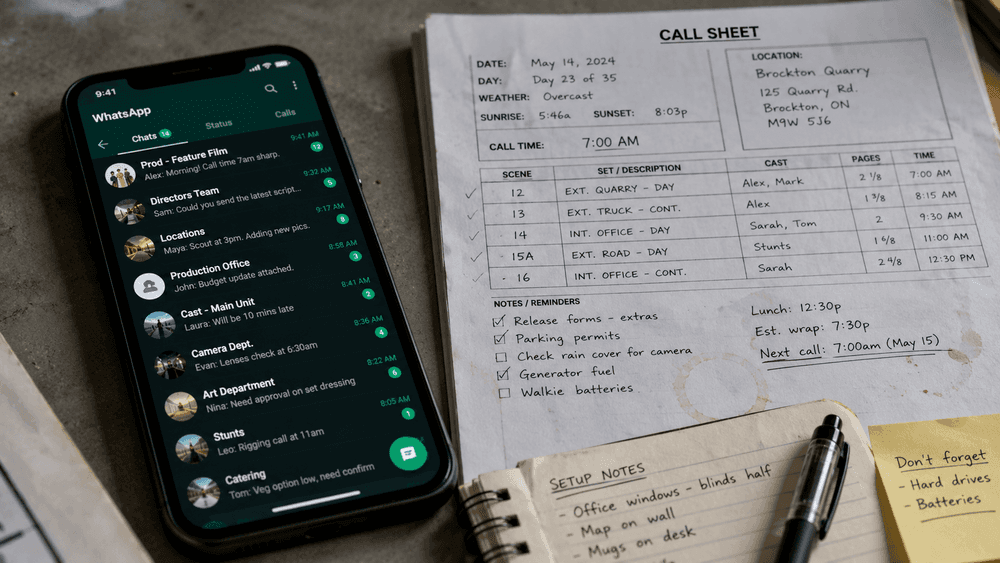
Open the WhatsApp Business app of any production manager in Mumbai at 11pm on a Wednesday and you'll find roughly the same thing: 47 unread messages across 12 active group chats, a casting shortlist screenshot now buried under 200 newer messages, three forwarded contracts from a client that need to go to legal in the morning, an audio note from a DOP about lens preferences that nobody's transcribed, and a single message that just says "confirm?" with no context.
This is not unusual. This is the operating system of Indian creative production.
Until you've watched a production manager scroll for several minutes trying to find the WhatsApp thread where a model agreed to a Sunday call time, you don't fully understand how much of the industry's actual work is retrieval — finding things you already know, in places they shouldn't be.
Why WhatsApp won in the first place
It would be easy to write a post lecturing the industry on its tooling. That's the wrong frame.
WhatsApp won for the same reason it always wins: it solved the actual problem.
When a casting agent in Versova needs to send a shortlist to an art director in Bandra at 9pm before a Monday shoot — and the art director is going to forward it to the client, and the client is going to share it with their CMO, and someone is going to ask follow-up questions in the same thread — there is no other tool in the world that does this with less friction. Not Slack. Not email. Not a project management platform.
WhatsApp's killer feature isn't messaging. It's that everyone you need to reach is already on it, and they will reply. That's a feature most enterprise software literally cannot compete with.
So pretending production teams should "just stop using WhatsApp" is the kind of advice written by people who have never actually run a shoot.
The threshold where it breaks
The problem isn't WhatsApp. It's that WhatsApp is a messaging app pretending to be a system of record — and that lie holds up perfectly until you cross a certain operational scale.
Roughly: five-plus people on the production team, thirty-plus projects a year, a roster of 200-plus creators you've worked with.
Below that, your team's collective memory is the system. Above that, the gaps start costing real money.
Here's what those costs actually look like.
Cost 1: Institutional memory walks out the door
A senior production manager resigns. With them goes four years of casting relationships, vendor history, the unwritten rule that you don't book a particular DOP for outdoor shoots in May, and the WhatsApp thread where a brand client mentioned in passing that they'd never approve a male model over 35.
None of this is in your CRM, because you don't have one. None of it is in a handover doc, because nobody writes those. It walks out the door, and the next person in that role spends eighteen months rebuilding from scratch what already existed.
I've seen production houses where the viability of an entire account depended on one person's phone. That's not a team. That's a single point of failure with a paycheck.
Cost 2: Decisions made in six different threads
A typical mid-sized shoot has at least four parallel conversations running: client thread, internal team thread, talent group, vendor coordination. Decisions get made in each one. Sometimes the same decision gets made differently in two of them.
The cost isn't a missed message. The cost is:
- The half-hour every morning when someone manually reconciles what was agreed where
- The awkward call when a client thinks they cancelled a shoot that's still on your call sheet
- The occasional five-figure mistake when a costume change discussed in the talent group never made it to the production thread
If you've ever had a producer say "but we agreed in the other group" — you've paid this cost.
Cost 3: The handover problem
When a project moves stages — pre-production to production, production to post — context has to move with it. In a system of record, this is a click. In WhatsApp, it's a forty-minute call where one team verbally downloads four weeks of context to another, and roughly thirty percent of it gets lost.
Multiply this by every project, every handover, every new hire. The compounded cost is enormous, but it never shows up on a P&L because it's distributed across hundreds of small inefficiencies. You just feel it as "we always seem to be busy but the margins are tight."
Cost 4: Compliance and liability
A model files a complaint about a shoot that happened fourteen months ago. Where is the booking confirmation? The signed release? The DM where they agreed to the call time?
In a WhatsApp chat, somewhere, on someone's phone, possibly auto-deleted if the storage filled up.
This used to be a theoretical risk. As Indian advertising and film face more scrutiny on talent compliance, GST documentation, and labor law, it's becoming a real one. Production houses without a proper system of record are quietly accumulating liability with every shoot.
What actually replaces WhatsApp
Here's the trap most attempts to "fix" production tooling fall into: they try to replace WhatsApp, when the right answer is to work alongside it.
WhatsApp is staying. It's where talent will continue to negotiate, where casting agents will continue to send shortlists, where eighty percent of the industry's communication happens. Any tool that demands you abandon it is going to lose.
What production houses actually need is a system of record that captures the durable artifacts — the talent profile, the booking confirmation, the contract, the call sheet, the invoice — while letting the conversation continue to happen wherever it happens.
The CRM is the spine. WhatsApp is the surface.
This is what Yurme CRM is built around. You paste a brief from a WhatsApp thread, and the system extracts the project, matches talent against your roster, drafts the proposal, and structures the call sheet — without asking you to abandon the channel where the actual work happens. The point isn't to make you stop using WhatsApp. The point is to give you something behind it that doesn't lose information.
The honest test
Here's the question to ask: if your most senior production manager handed in their notice tomorrow, how much of your operational knowledge would walk out with them?
If the answer is "most of it," you don't have a tooling problem. You have a systems problem. WhatsApp didn't cause it, but it's not going to solve it either.
That's the real cost. Not the messages you've missed. The institutional knowledge you never wrote down.
Yurme CRM is the system of record built for India's creative production industry. It works alongside WhatsApp, not against it. See how it works →