
What AI Actually Does in Creative Production (And What It Doesn't Yet)
Every production tool now claims to be AI-powered. An honest map of what AI actually does in creative production today — and what's still marketing.
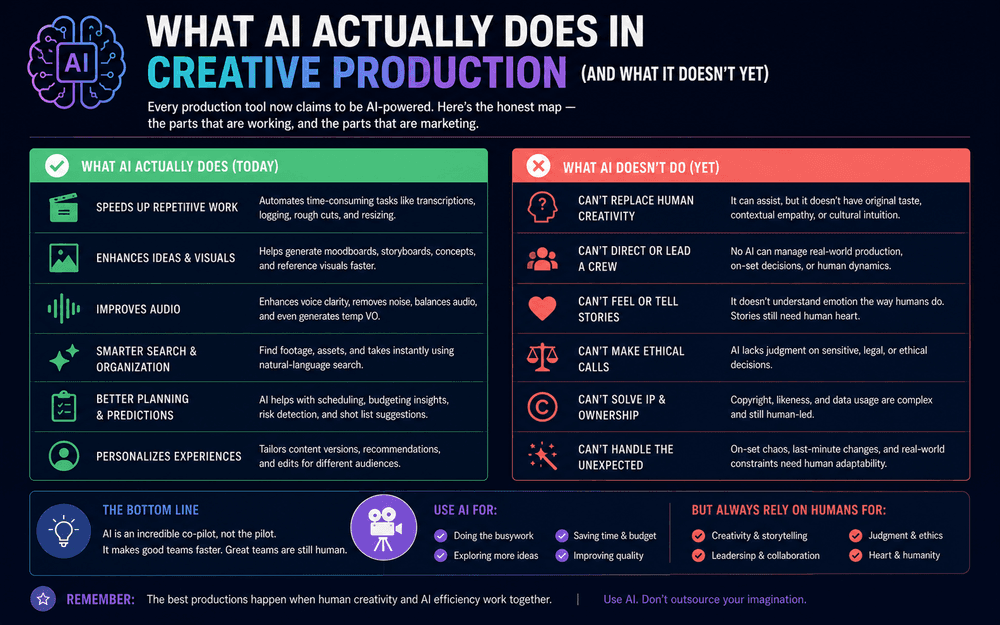
If you've sat through a demo for any creative production tool in the last eighteen months, you've heard the phrase *AI-powered* at least four times. Sometimes it means something. Often it's a wrapper around a search feature that was there five years ago.
This is a problem, because the actual gains from AI in creative production are real — and they're being buried under a mountain of press releases. Producers reading their fifteenth *"AI-native"* announcement of the quarter are learning to tune the whole category out, which means they'll miss the parts that would genuinely help them.
Here's a working map of what AI is actually doing in Indian creative production right now, what it's still overhyped for, and where the line sits between the two.
What's working
1. Parsing briefs into structured work
The single most valuable thing AI does in production today is take a messy brief and turn it into a structured project.
The scenario every production manager knows: a client sends a brief — sometimes as a PDF, sometimes as a rambling email, sometimes as a WhatsApp voice note from their CMO. The document contains, buried in it, the shoot dates, the deliverables, the talent requirements, the usage rights, the location, the budget, and roughly forty implicit assumptions. Someone on your team then spends two hours pulling all of that out and setting up the project.
This is exactly the kind of work large language models are genuinely good at. Given a brief, they can extract structured fields — project name, shoot date, deliverables, talent brief, usage — with high accuracy. What used to be two hours becomes two minutes.
This isn't a demo trick. It's operational, it works today, and the time savings compound across a production house doing dozens of briefs a month.
2. Matching talent against a known roster
If your production house has worked with three hundred photographers over the last five years, no human on your team remembers which ones are strong on wellness shoots, prefer natural light, and are available in Bengaluru this week.
But a decent AI matching model, given a talent database with the right metadata, can surface the right ten names in seconds. This is where the marketplace + CRM combination becomes powerful — the more historical data you feed the system, the better the matches get. The moat isn't the algorithm. It's the data.
The producers who've adopted this properly describe the same feeling: they stop defaulting to the last three people they worked with, because they can now actually see the full roster.
3. Drafting repeated artifacts
Call sheets. Invoices. Contract drafts. Proposal decks. Every production house produces dozens of these a month, and eighty percent of the content is repeatable. AI is genuinely good at generating strong first drafts of these documents from structured project data.
The key phrase is *first drafts.* A producer still reviews, adjusts, and sends. But the blank-page problem is gone, and that alone recovers hours per week.
4. Institutional search
*"When did we last shoot in Mahabalipuram?" "Who was that makeup artist we booked in Q3 last year?" "What did we quote to that skincare brand for the last two campaigns?"*
These are questions that used to require the person on the team with the longest institutional memory, plus a scroll through Google Drive that took thirty minutes. AI-powered search over your own project archive is now good enough that anyone on the team can answer them in seconds.
This is quiet, un-glamorous, and one of the highest-value applications happening today.
What's overhyped
1. Creative judgment
Every few months, someone releases a tool that promises "AI-generated storyboards" or "AI-optimised creative direction." Producers try them, get outputs that are technically impressive and creatively hollow, and quietly stop opening them.
Creative judgment — is this the right actor for this role, is this the right mood for this brand, is this the right cut — is not something current AI does well. It generates plausible options. It doesn't know why one option is right for this specific brand in this specific market at this specific moment. That knowledge sits with humans, and it's going to for a while.
The frame that works: **AI takes over the operational load so humans have more energy for creative judgment.**
The frame that doesn't work: **AI replaces the judgment itself.**
2. Chemistry and casting decisions
Related but worth calling out separately. There is a growing category of tools promising "AI casting" — matching actors to roles based on some combination of face detection, past performance data, and stated preferences.
These are useful for shortlisting. They are not useful for casting.
Casting is thirty percent technical fit, thirty percent chemistry with the rest of the ensemble, thirty percent intangibles the director feels in the room, and ten percent politics you'll never model. Anyone selling AI as a casting *decision* tool is selling you the first thirty percent and hoping you don't notice the other seventy.
3. Client relationships
The current wave of "AI account managers" and "AI client-facing agents" is going to end in tears.
Brand clients in India — especially senior ones — will notice within one exchange that they're talking to a machine, and it will damage the relationship in ways that outlast whatever efficiency the tool provided. AI can draft the follow-up email. It should not send it.
4. Full autonomy
The current fantasy in some quarters is *agentic* AI that runs an entire production workflow autonomously — takes a brief, casts the actors, negotiates the contracts, schedules the shoot, delivers the assets.
This will not happen soon in creative production, for a simple reason: creative production runs on hundreds of small human relationships, and every one of those relationships involves negotiation, context, trust, and taste. An AI cannot maintain a relationship with a casting director in Andheri who has an opinion about your last three shoots. It can help you *remember* that opinion. It cannot replace it.
The frame that actually works
The useful way to think about AI in creative production, at least right now, is as **operational infrastructure** — not creative substitute.
AI is good at:
- Reading
- Structuring
- Matching
- Drafting
- Searching
These are the operational muscles of a production house. They're also the parts of the job that consume the most time and add the least creative value.
AI is not good at:
- Deciding
- Negotiating
- Casting
- Directing
- Maintaining relationships
These are the creative and commercial muscles. They're also the parts that clients actually pay for.
A production house that gets this frame right will end up with humans spending more time on the creative and commercial work, and less on the operational overhead. That's a real productivity gain — often meaningful, sometimes close to a 2x on operational throughput per producer, if the implementation is honest.
A production house that gets the frame wrong — usually by buying tools that promise creative judgment — will get outputs that look impressive in a demo and don't survive contact with a real client.
What we're doing at Yurme
For what it's worth, this is the framing Yurme CRM is built around.
Our *brief-to-everything* workflow is exactly Case 1 above — take a messy brief, extract the structured project, populate the talent roster, draft the proposal. It saves hours, it works today, and it's calibrated to leave the creative judgment to the producer.
We are deliberately not building AI casting decisions. We are not building autonomous client agents. We are not building AI storyboard generators.
What we are building is the operational spine that lets your team stop wasting hours on the parts of the job that shouldn't be human work in the first place — so the human work can actually be good.
That's the honest case for AI in creative production. Everything else is press releases.
*Yurme CRM is the AI-powered system of record for Indian creative production. [See how brief-to-everything works →](https://yurme.com/enterprise)*