
One Wrong Instruction Cost This Production House an Entire Shoot Day
A real story from a production shoot — and why the problem wasn't the art director. It was the absence of a system. Here's what a production OS actually prevents.
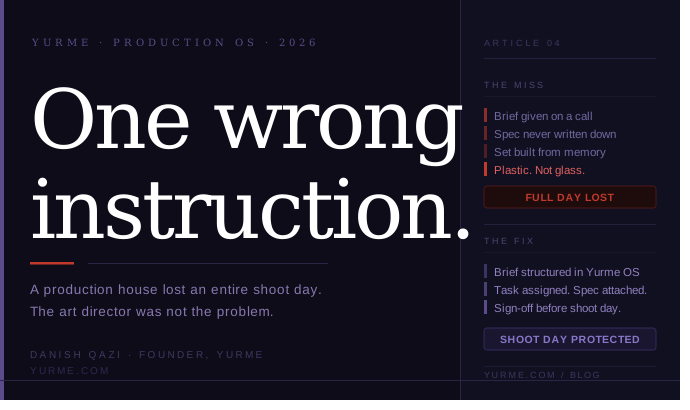
A real story — and why the problem was never the art director.
The day everything stopped
The shoot was planned. Location confirmed. Crew booked. Equipment loaded. The creative director arrived on set, walked through the space, and stopped.
The art director had built the set exactly as he understood it. An office cabin. Clean lines. Proper lighting rig in place. Everything looked right — until the creative director looked at the cabin wall.
The glass was plastic.
The shoot required a real glass panel in the cabin wall. The creative director had always intended a real glass panel. It was what made the shot work — the camera positioned outside, shooting through the glass at the subject inside. A specific, considered, creative choice.
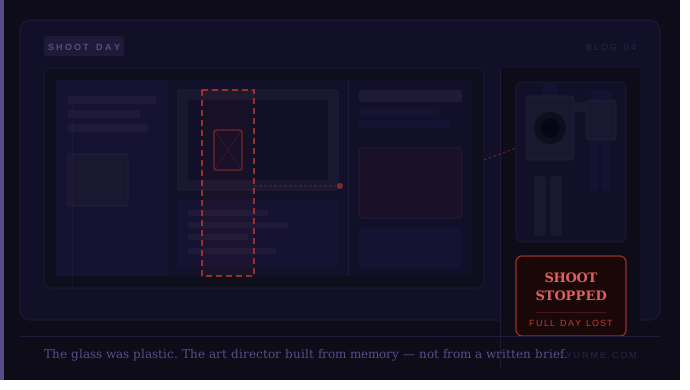
One missed instruction. One full day lost. Location, equipment, crew, client time — all of it paid twice.
The art director was not careless. He built what he believed was specified. The creative director was not unreasonable. He had a clear vision for the shot. Nobody on that set was incompetent.
The system was.
The real culprit was never the art director
When something goes wrong on a shoot, the instinct is to find the person who made the mistake. In this case, the art director ordered the wrong material.
But ask a harder question: where was the brief written down?
Where was the spec for the glass panel documented? Where was the art director's understanding of the requirement confirmed in writing? Where did the creative director sign off on the set design before shoot day?
The answer, in most production houses in India, is: it wasn't. The instruction was given on a call. Or mentioned in a site visit that nobody took notes on.
The art director had no written brief to refer back to. The creative director had no approval record to point to. The production house had nothing — no evidence of what was agreed, no paper trail, no way to understand exactly where the chain broke.
The problem was not the art director. The problem was that the instruction existed only in someone's memory.
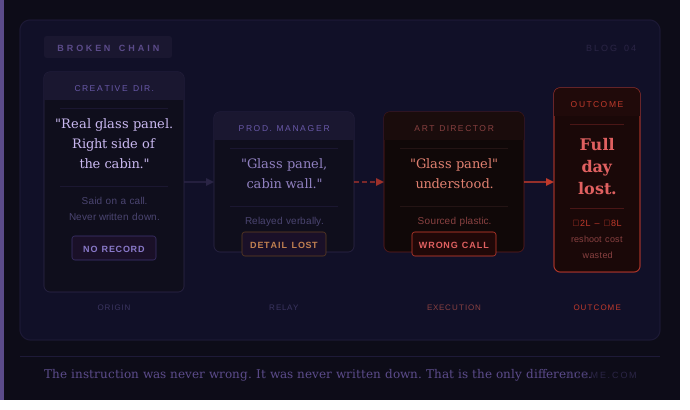
Every production house has a version of this story.
A costume that arrived in the wrong colour because the brief said "blue" and nobody specified which blue. A location that the driver took to the wrong address because the confirmation message had two addresses and he picked the first one. A talent who showed up at 7am when the call time was changed to 9am — but the update only went to the group the talent wasn't added to.
The industry has normalised these as "shoot day problems." Small fires. Part of the job. The kind of thing experienced production managers handle.
But they are not inevitable. They are the predictable output of running a production business without a proper operating system.
The shoot day problem always has a pre-shoot day cause. A brief that was never structured. A task that was assigned verbally. An approval that never happened in writing. A gap in the production chain that nobody spotted because nobody had visibility of the full chain.
The cost is not just financial — though that is significant. It is the client relationship. The creative director's confidence in the production house. The talent's trust that the information they receive is accurate. The team's morale when a shoot that should have run cleanly falls apart over something preventable.
What a production OS actually does — stage by stage
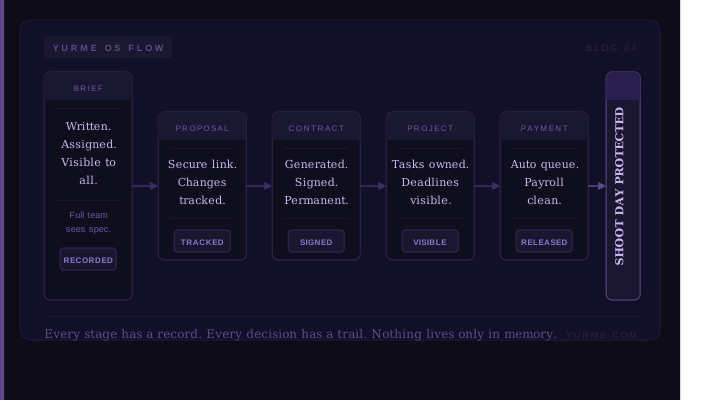
Brief
Without a system: Shared verbally or on a call. No written record. Misremembered.
With Yurme OS: Structured job brief created in the platform. Every detail written, assigned, and visible to the full team.
Proposal
Without a system: PDF sent over email. Client makes changes verbally. Nobody has the final version.
With Yurme OS: Proposal built and shared via a secure client link. Changes tracked. Final version always clear.
Contract
Without a system: Verbal rate agreement. Disputed three weeks later. No paper trail.
With Yurme OS: Contract generated from the proposal. Both parties confirm. Signed record stored permanently.
Project
Without a system: Tasks in someone's head. Deadlines in a spreadsheet nobody updates. No visibility.
With Yurme OS: Every task assigned with spec, deadline, and owner. Full project visibility for the whole team.
Payment
Without a system: Talent chasing payment. Finance team guessing who was paid. GST not tracked.
With Yurme OS: Payment queue auto-generated from confirmed bookings. Payroll calculated. Records clean.
Credits
Without a system: Work completed. Nobody records it. Talent cannot prove they did it.
With Yurme OS: Every completed booking generates a verified Yurme Credit. Permanent, fraud-proof career record.
In the glass panel story, the failure happened at the Brief stage. A task was assigned — build a set with this spec — but the spec lived on a call, not in the system. With Yurme OS, that brief is written, structured, and attached to the art director's task. He can see it. The creative director can see it. The production manager can see it. Before shoot day, the set design is reviewed and approved through the platform. Both sides confirm. There is a record.
The shoot day problem never happens. Because the pre-shoot day system worked.
The cost of not having a system
It is easy to absorb the cost of individual shoot day problems. A reshoot here. A delay there. Part of the business.
Until you add it up.
A single unplanned additional shoot day on a mid-size ad film production in India — location, equipment, full crew, client management — typically costs between ₹2 lakhs and ₹8 lakhs. Depending on the production, that can be the entire margin on the project.
But the financial cost is only one part. The other cost is invisible and cumulative:
- The client who decides not to work with you again after a shoot that ran badly
- The talent who stops trusting your call sheets because the information is always changing
- The senior production manager whose institutional knowledge walks out when they leave, because nothing was ever recorded
- The agency that loses the pitch because they could not show the client a professional proposal and contract workflow
- The creative director who cannot trust the execution because there is no sign-off process
None of these appear on a balance sheet. But every production house that has been operating for more than three years has felt every single one of them.
The margin is not lost on shoot day. It is lost in the weeks before it — in every unstructured brief, every verbal approval, every task that lived only in someone's memory.
Your team runs on WhatsApp. Your business should run on Yurme.
The best production houses in India do not run tighter ships because they have better people. They run tighter ships because they have better systems.
A system where the brief is written before the task is assigned. Where the approval happens before the shoot day. Where the contract exists before the payment is discussed. Where every completed project builds a verified record — for the production house and for every person who worked on it.
Yurme OS is that system. Built specifically for how India's creative production industry actually works — from the first lead to the final credit.
Your team will keep communicating the way they always have. Yurme makes sure that what matters never gets lost.